
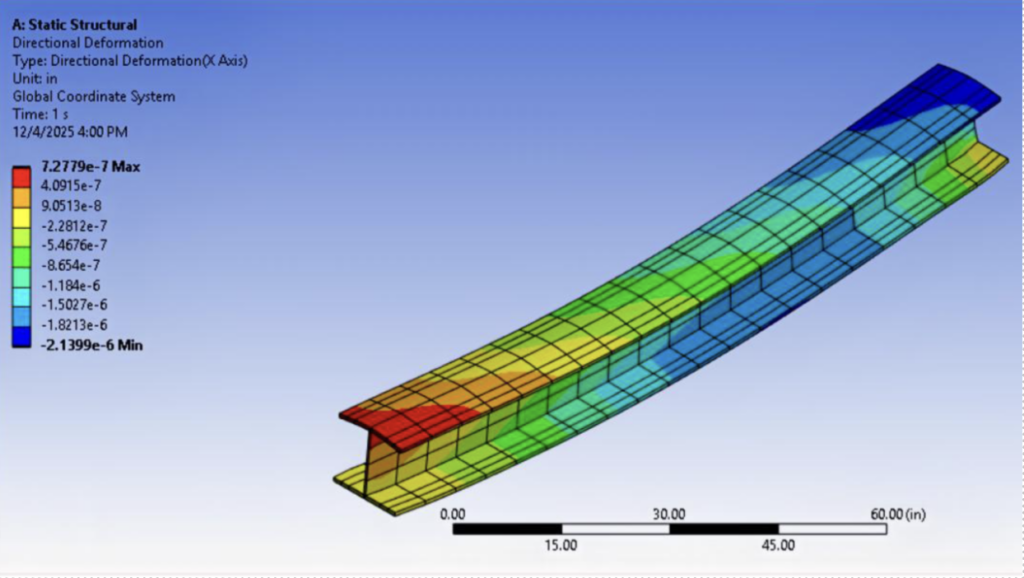
Definition:
Finite Element Analysis is a computational method used to analyze how a physical structure or system behaves under different loads in accordance with the laws of physics. Finite Element Analysis is commonly used in the analysis of complex structures including buildings and structural components under indeterminate loads.
Pre-Analysis Checklist
Input:
Confirm data sources are accurate and up to date for dimensions, initial conditions, boundary conditions, materials, and loadings.
Load Path:
Confirm that the load path is logical and that the load is being transferred correctly through the structure to the supports
Pre-Processing Checklist
Geometry:
Confirm dimensions with design and/or as-built drawings engineering drawings.
Account for geometric discontinuities.
Material Properties:
Confirm materials with design and/or as-built drawings engineering drawings and/or engineering reports.
Ensure the correct type of materials are utilized (i.e isotropic materials vs. anisotropic vs. orthotropic materials and so on.)
Account for material non-linearities.
Elements:
Select element types with respect to application (i.e. shell elements for plates, frame elements for beams and so on).
Account for geometric non-linearities.
Meshing:
Check mesh quality, including element distortion, and perform a mesh sensitivity study if necessary.
Initial Conditions:
Confirm Initial Conditions based on design and/or as-built drawings engineering drawings and/or engineering reports.
Boundary Conditions:
Confirm Boundary Conditions based on design and/or as-built drawings engineering drawings and/or engineering reports.
Loads:
Verify or validate Loadings against hand/model calculations or testing data, respectively.
Solution Checklist
Solver:
Confirm solver type is accurate for the analysis desired (i.e. static linear elastic solver vs. dynamic non-linear analysis and so on.)
Post-Analysis checklist
Model Validation/Verification:
Verify or validate reactions against hand/model calculations or testing data, respectively.
Results Review:
Check deformation and stress results for accuracy in both magnitude and direction.
When You and Your Team Need Civil/Structural Support
Give Us A Call!
Vanessa Malone, P.E.
Principal | Preeminent Solutions, Inc.
(321) 244-8699
(407) 901-0133
info@psengrinc.com
www.psengrinc.com