Per American Concrete Institute “Building Code Requirements for Structural Concrete and Commentary,“ ACI 318-19, Chapter 19, key environments including marine environments, and heavy industrial environments may constitute harsh environments for reinforced concrete.
Marine environments provide ion-rich environments that may result in chloride-induced reinforcement corrosion and chemical attacks on reinforced concrete structures.
Such corrosion and attacks ultimately lead to degradation reinforced concrete structures over time.
It is the responsibility of structural engineers to appropriately assess concrete structures in marine environments to reduce risk to life and property and to ensure existing structures provide adequate strength and durability throughout the life of the structure.
What Are At-Risk Marine Structures?
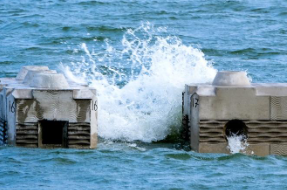
Examples of At-Risk Marine Structures include:
Transportation Structures: (i.e. Docks, Ports, Bridges, Tunnels)
Energy Infrastructure: (i.e. Offshore Platforms, Pipelines),
Coastal Protection: (i.e. Seawalls, Breakwaters)
Environmental Structures: (i.e. Artificial Reefs)
What Is the “Splash Zone” and How Does it Relate to Marine Environments?
Splash Zones (aka. The Tidal Zones) are areas of the structure that experience alternating cycles of wetting and drying.
Per ACI 222.3R-11 “Design and Construction Practices to Mitigate Corrosion of Reinforcement in Concrete Structures”, splash zones are ”generally the most susceptible [areas] to corrosion because of the availability of water, oxygen, and chlorides.”
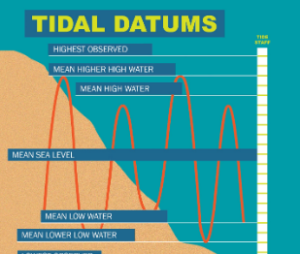
In addition to in-situ testing, structural engineers may check for areas within the splash zone, by referring to the tidal datums available for the project location.
Such information is readily available on sources such as National Oceanic and Atmospheric Administration (NOAA) Tides and Currents database for the project location.
So, What Are the Signs of Deterioration?

Cracking
Per ACI Committee 222, cracks that run parallel to reinforcing steel are a main concern.
Such cracks reduce the service life of the structure by allowing localized penetration of carbonation to the reinforcing steel.
Such cracks also reduce the service life providing a direct path for chloride ions, moisture, and oxygen to the reinforcing steel.
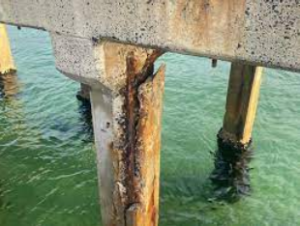
As corrosion progresses, these cracks can widen significantly, leading to spalling and delamination.
It is advised to consult structural engineer and to repair cracks sooner than later.
Spalling/Delamination
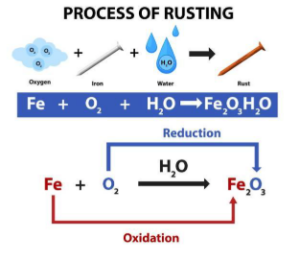
Once the iron, Fe(III), of the reinforcing steel repeatedly comes into contact with sea water and oxygen, Rust, i.e. Iron(III) Oxide (Fe2O3·nH2O), begins to form and expand
Such expansion results in further cracking and may ultimately lead to the delamination and loss of the concrete cover resulting in further exposed reinforcement.
It is advised to consult structural engineer and to mitigate delamination sooner than later.
Rust Stains
The oxidation of the iron, Fe(III), of the reinforcing steel results in the formation of rust.
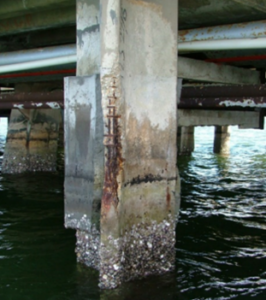
Visible signs of rust include the appearance of red-colored or brown-colored stains on the concrete surface.
Such stains are often near cracks or the location of the rebar.
Concrete Pitting
Pitting involves the formation of small cavities on the concrete surface.
Such cavities indicate localized disintegration of the concrete matrix.
It is advised to consult structural engineer and to repair pitting sooner than later
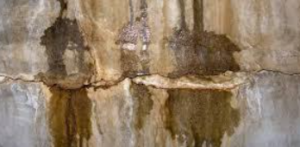
Efflorescence
Efflorescence refers to the residue that forms on a structure when water carries the soluble minerals to the concrete surface and then evaporates, leaving salts behind.
Although efflorescence is typically an aesthetic issue, extensive and prolonged efflorescence may result in reduced strength of the associated concrete.
Consult a structural engineer for remediation options.
Early detection through regular visual inspections and non-destructive testing is crucial to manage and mitigate further damage to reinforced concrete structures.
When You and Your Team Need Civil/Structural Support
Give Us A Call!
Vanessa Malone, P.E.
Principal | Preeminent Solutions, Inc.
📞 (321) 244-8699 | (407) 901-0133
✉️ info@psengrinc.com
🌐 www.psengrinc.com