Per American Concrete Institute (ACI) “Building Code Requirements for Structural Concrete and Commentary,“ ACI 318-19, Chapter 19, key environments including marine environments, heavy industrial environments, sulfate-rich environments, and environments with extreme temperature change may constitute harsh environments for load-bearing reinforced concrete structures.
Structural engineers must design load-bearing reinforced concrete structures (i.e. beams, columns, and slabs) such that the structures operate to the standard expected for the industry and such that the structures provide both adequate strength and durability.
What Are Examples of Structures with Harsh Environments?
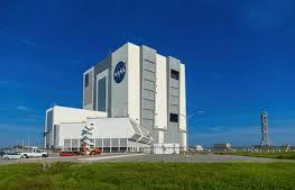
Examples of Heavy Industrial Structures with Harsh Environments include:
- Energy Facilities: (i.e. Nuclear Power Plants, Oil & Gas Refineries, Petrochemical Plants, and Gas/Hydroelectric Facilities.)
- Manufacturing Facilities: (i.e. Aerospace Manufacturing Facilities, Aviation Manufacturing Facilities, Automotive Assembly Plants, Cement Plants, Clinker Plants, Steel Mills)
- Infrastructure Facilities: (i.e. Large Dams, Ports, and Specialized Facilities for Waste Treatment or Hazardous Material Storage)
- Materials Processing Plants: (i.e. Metal Forges, Foundries, Glass Production Facilities, and Mining Operations.)
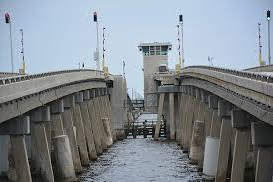
Examples of Marine Structures with Harsh Environments include:
- Transportation Structures: (i.e. Docks, Ports, Bridges, Tunnels)
- Energy Infrastructure: (i.e. Offshore Platforms, Pipelines),
- Coastal Protection: (i.e. Seawalls, Breakwaters)
- Environmental Structures: (i.e. Artificial Reefs)
What Are the Causes of Deterioration?
Signs of deterioration in a concrete structure largely depend heavily on the structure age, initial design, environment, and loading.
In general, we can expect signs of deterioration in older, under-designed structures in harsh environments after repeated exposed to higher loads.
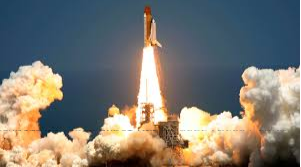
In general, higher loads include:
Wind Loads
Seismic Loads
Blast Loads,
Thermal Loads
Vibration Loads
Per ACI 201.2R-16, “Guide to Durable Concrete,” in general, harsh environments include environments that impose the following attacks unto the concrete:
Sulfate Attacks
Chloride Attacks
Salt Attacks
So, What Are the Signs of Deterioration?

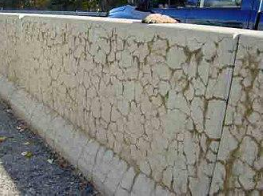
Concrete Cracking
Per ACI 224R-01 “Control of Cracking in Concrete Structures” cracks in concrete structures may indicate major structural problems in the element.
There are many causes of cracking.
That said, cracks in excess of code recommended maximums – such as cracks in excess of cracks in excess of 0.10mm in water retaining structures – must be investigated (ACI 224R-01, Table 4.1)
Such cracks reduce the service life of the structure and may foster corrosion of the reinforcing steel.
It is advised to consult structural engineer and to repair cracks sooner than later.
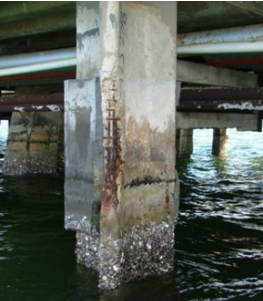
Spalling/Delamination
In advanced cases, cracking may ultimately lead to the delamination spalling.
Spalling results in the loss of the concrete cover resulting in further exposed reinforcement
It is advised to consult structural engineer and to repair cracks sooner than later.
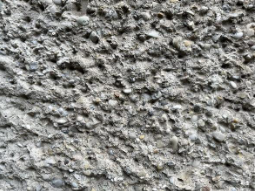
Concrete Pitting
Pitting involves the formation of small cavities on the concrete surface.
Such cavities indicate localized disintegration of the concrete matrix.
It is advised to consult structural engineer and to repair pitting sooner than later
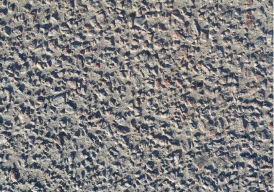
Concrete Scaling / Flaking
Concrete scaling is the flaking or peeling of the top layer of hardened concrete,.
Scaling is commonly caused by freeze-thaw cycles.
Scaling is also caused by poor finishing (like troweling in bleed water) or inadequate curing.
Scaling leads to a weaker structure.
It is advised to consult structural engineer and to repair scaling sooner than later
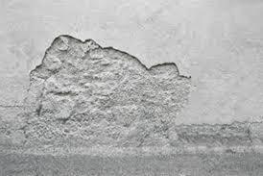
Efflorescence
Efflorescence refers to the residue that forms on a structure when water carries the soluble minerals to the concrete surface and then evaporates, leaving salts behind.
Although efflorescence is typically an aesthetic issue, extensive and prolonged efflorescence may result in reduced strength of the associated concrete.
Consult a structural engineer for remediation options.
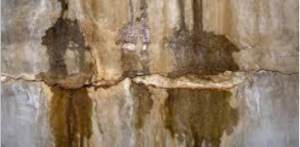
Early detection through regular visual inspections and non-destructive testing is crucial to manage and mitigate further damage to reinforced concrete structures.
When You and Your Team Need Civil/Structural Support
Give Us A Call!
Vanessa Malone, P.E.
Principal | Preeminent Solutions, Inc.
📞 (321) 244-8699 | (407) 901-0133
✉️ info@psengrinc.com
🌐 www.psengrinc.com