
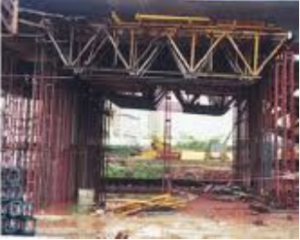
Per the CalTrans Falsework Manual (2020), a leading authority on the matter, falsework includes any temporary structure used to “support the permanent structure until it becomes self-supporting.”
Falsework typically includes steel or timber beams, girders, posts, foundations, and any proprietary equipment including modular shoring frames, post shores, and horizontal shoring.
Falsework may be colloquially called “shoring”, “bracing”, “temporary support systems”, etc.
Similarly falsework may be used in retrofit work when failed structural elements/components are required to be replaced.
When determining the design of falsework several key
steps are important to ensure a safe and economical
design.
This article will discuss such steps.
Purpose and Scope
Engineers must design falsework to meet the needs of the system. Considerations including risk assessment, site considerations, load path, specialty loadings, compatibility, and so forth are required to ensure a safe design.
Further details are listed below:
Scope: Engineers and contractors must agree on the minimum deliverables, requirements, constraints, and key milestones to ensure a shared understanding and prevent “scope creep”.
Schedule and Key Milestones: Engineers and contractors must identify major timelines and milestones to ensure safety and avoid schedule overruns.
Construction Sequence: Engineers and contractors must identify a logical construction sequence to ensure safety and avoid schedule overruns.
Risk Assessment: Engineers and contractors must identify and mitigate hazards to ensure a safe falsework plan and to ensure safe erection, operation, and demolition of falsework and temporary support systems.
Such assessment may include the design of fall-protection systems.
Such assessment should also take into consideration the expected duration of use of the falsework.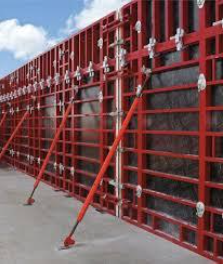
Pre-Design Review
Engineers must design falsework to meet the needs of the system.
Considerations, including risk assessment, site considerations, load path, specialty loadings, and compatibility, are required to ensure a safe design.
Further details are listed below:
Regional Site Considerations: In addition, to a basic Risk Assessment, Engineers must design falsework to meet the safety requirements of the site.
This is most notable for falsework intended for:
Seismically-Active Regions
High Wind Loads Regions
Blast-Prone Areas
High-Vibrations Load Areas
High-Water Table Areas
Potential Future Loads
Load Path and Compatibility
Engineers must utilize the load path and compatibility with the existing system to design suitable falsework to meet construction needs.
Falsework must be compatible with the overall construction sequence and the permanent structure’s design and not impart additional/unanticipated loads unto permanent structure.
Likewise, engineers must design falsework member and connections to resist loads along:
The Horizontal Load Path
The Vertical Load Path
Loads
Similarly, falsework must be designed to resist key loads including
Construction Loads
Dead Loads
Equipment Live Loads
Vehicular Live Loads
Pedestrian/Worker Live Loads
Wind Loads (where appropriate)
Earthquake Loads (where appropriate)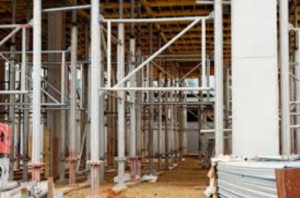
Deflection Requirements: Engineers must design falsework with sufficient stiffness to allow for deflections below the maximum permitted deflection.
For example for beams the maximum permitted deflection is typically:
Maximum Allowable Deflection
The maximum allowable beam deflection is limited to:
Δ𝐦𝐚𝐱 ≤ 𝐋/𝟐𝟒𝟎
where :
Δ𝐦𝐚𝐱 = Max allowable beam deflection
L = Span length of falsework beam
Minimum Clearances: Engineers must design falsework to maintain required horizontal and vertical clearances. This is especially true for falsework located over or adjacent to roadways or railroads. Specific attention to horizontal and vertical clearances, protection from impact loads, and adequate lighting is required.
Anchorage Requirements: Engineers must design anchorage to meet the requirements based on the vertical and horizontal load path.
Structural Design, Analysis & Stability:
Engineers must perform a detailed engineering analysis to ensure stability and resistance to both vertical and lateral forces.
Design and analysis must account for stresses in load carrying members, deflection limitations, and so forth.
Depending on the design bracing, anchoring, and proper foundations may be required to prevent settling or overturning.
Consult local codes for further details.
Construction Administration:
Engineers should be on site to ensure best implementation of design.
Conclusion:
In conclusion, designing falsework can be difficult but it doesn’t have to be.
With proper design and implementation engineers and contractors can provide, safe, secure, and reliable falsework for present and furture projects to come.
When You and Your Team Need Civil/Structural Support
Give Us A Call!
Vanessa Malone, P.E.
Principal | Preeminent Solutions, Inc. (321) 244-8699 | (407) 901-0133
 info@psengrinc.com
 www.psengrinc.com