
AN AIRLINE CASE STUDY
Introduction
AN AIRLINE TRAINING FACILITY
Preeminent Solutions, Inc. has been engaged to provide structural engineering services for a Training Facility. The project involves the evaluation and structural design of new wall openings in an existing off-terminal tilt-wall concrete building that forms part of a 30,000 SF training facility complex.
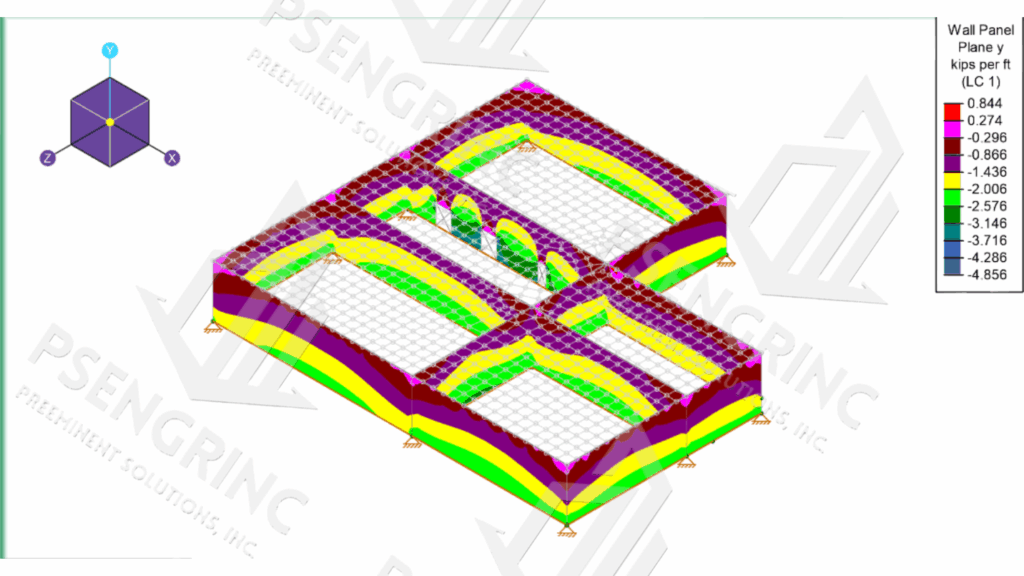
The facility is being redeveloped to accommodate an airline training and administrative operations, including new restrooms, breakroom with kitchenette, offices, training rooms, maintenance shop, and mechanical upgrades.
For the purpose of this study, the existing concrete wall separating the north and south suite plans was inspected to evaluate conditions related to the proposed new wall openings and the previously removed and infilled section.
Problem Statement / Objectives
Two openings are proposed along the south suite wall, which separates multi-spaces oriented north–south. A previous 6′-4″ north opening was infilled with gypsum and stud construction, with the concrete already removed. The client has now requested a new 6′-8″ south opening to improve internal circulation and visibility between suites.
Preeminent Solutions will perform field verification, analysis, and design of the proposed wall modifications to ensure the structural integrity of the tilt-wall panels is maintained. The scope includes assessing the existing wall system, determining reinforcement and load transfer behavior, and designing appropriate headers, frames, or reinforcements to safely accommodate the openings in compliance with current Florida Building Code requirements.
Due to several existing unknowns regarding the wall construction and reinforcement, further inspection, testing, and review of original structural and as-built drawings will be required to confirm design assumptions. In addition, given the extent of the modifications and potential deficiencies observed, a detailed structural analysis is recommended prior to implementing any major repair or retrofit.
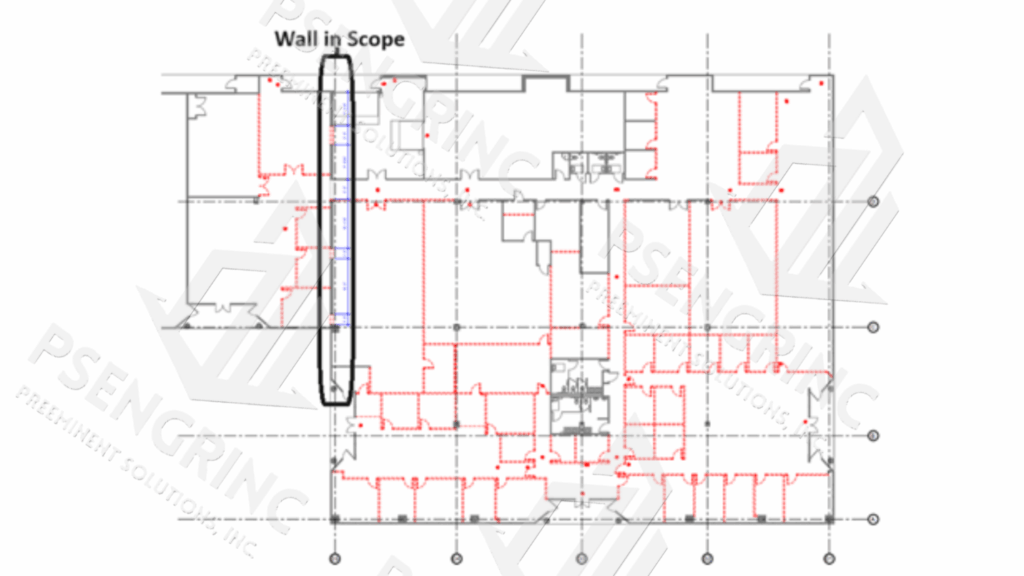
• Structural Description – Tilt-Wall Building
For the purpose of this study, only the existing tilt-wall concrete wall system and adjacent roof structure at the SWA–MCO Training Facility were reviewed to assess conditions relevant to the proposed new wall openings.
Tilt-Wall and Structural Framing System
The building is a single-story, 30,000 SF tilt-up concrete structure with load-bearing tilt-wall panels forming the exterior envelope and several interior demising walls dividing multiple suites along a north–south axis.
Each tilt-wall panel is supported on reinforced concrete foundations and connected to a steel roof framing system that provides overall lateral and gravity load resistance. The tilt panels function as both vertical load-bearing and lateral shear-resisting elements.
The roof system consists of open-web steel joists spanning between tilt-wall panels and/or steel beams, supporting corrugated metal decking with an applied roof membrane. Specific details such as joist size, spacing, deck gauge, and deck-to-joist connection type were not available at the time of this report. Verification through as-built drawings or field testing is recommended.
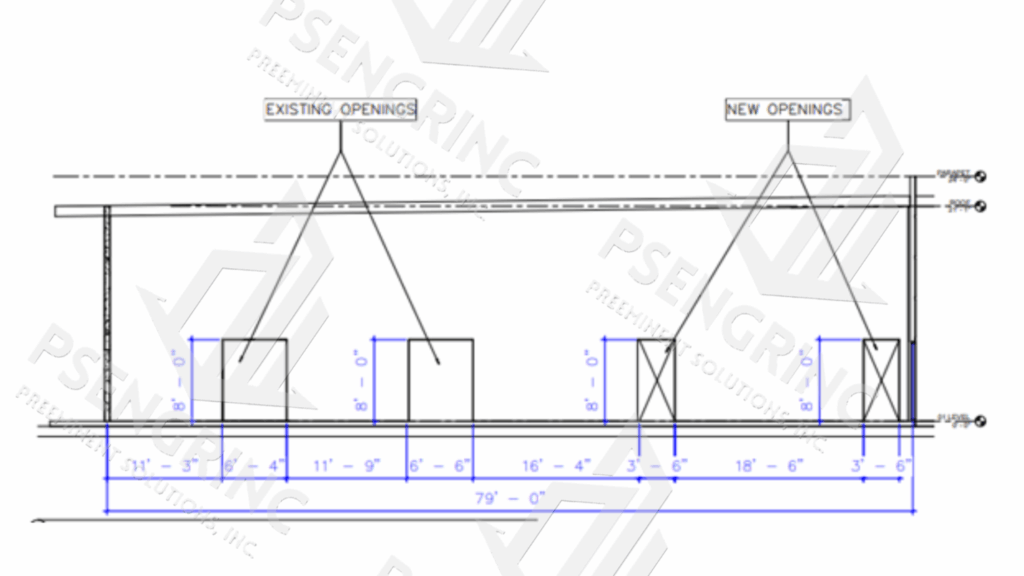
• Structural Description – Wall Construction and Openings
The interior concrete wall separating the north and south suites serves as a primary structural partition within the building. The wall contains one previously modified 6′-4″ opening (currently infilled with gypsum/stud framing) and a proposed 6′-8″ new opening to be cut through the concrete.
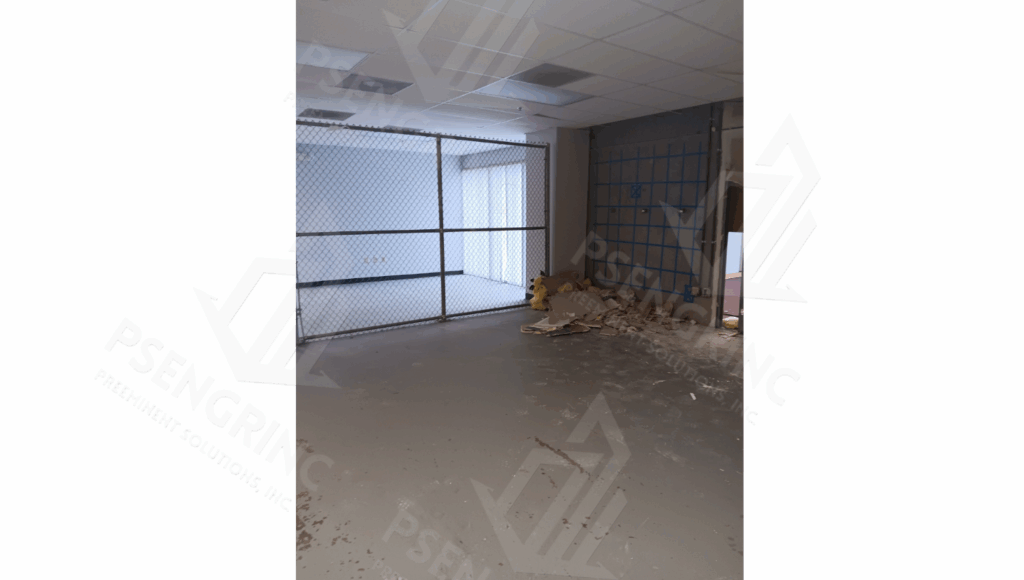
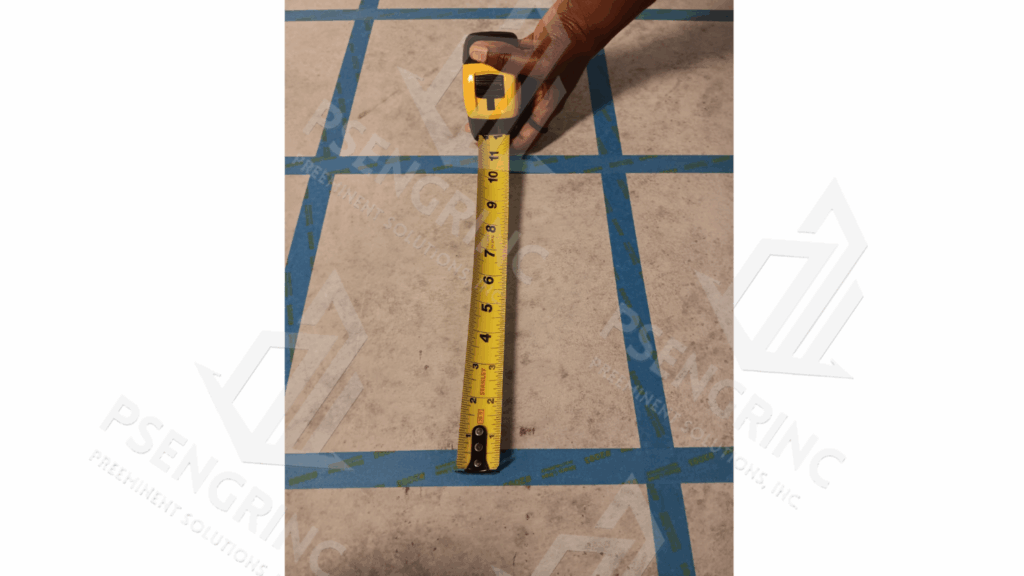
The concrete thickness, reinforcement configuration, and connection details at the wall and roof interface remain unknown pending field verification and review of original or as-built structural drawings. Further inspection and limited non-destructive testing (NDT) are advised to confirm reinforcement and load path continuity.
• Structural Description – Roof and Mechanical Support
The roof framing supports multiple rooftop units (RTUs) and mechanical equipment. All existing RTUs are scheduled for replacement, and any structural reinforcement required for new unit loads will be addressed in subsequent design phases. The roof diaphragm provides lateral stability to the tilt-wall panels and must remain continuous during wall modifications.
Due to the degree of unknown conditions—including reinforcement layout, concrete strength, deck properties, and connection details—additional inspection, testing, and review of original drawings are required prior to final analysis and retrofit design.
Analysis / Findings
• Site Description
The site is generally flat and developed, surrounded by other commercial and aviation-related facilities.
According to Federal Emergency Management Agency (FEMA) flood mapping data, portions of the surrounding area are classified within a Special Flood Hazard Area (SFHA). However, the project site itself is situated on elevated ground relative to nearby flood zones.
The nearest USGS groundwater monitoring station identified for the area is USGS 282835081305201 — Palm Lake Drive Well (near Windermere, FL) (Lat 28°28’39”, Long 81°30’26”). The USGS record lists a land-surface altitude of 158.69 ft above NGVD29 and maintains historical groundwater-level data for the Floridan aquifer system; the station is located roughly 5 miles from the project site.
Client-supplied survey data reports a base finished floor elevation (FFE) of 96.3 ft NAVD88 for the facility. This client-provided elevation should be verified against the official survey, an elevation certificate, or the Orange County GIS prior to final design. Because the USGS station datum and local survey datums differ (NGVD29 vs NAVD88), numerical comparisons require datum conversion and careful interpretation.
• Code Consideration and Key Areas of Interest
This report focuses on the inspection and evaluation of the existing structural wall at the Southwest Airlines MCO Training Facility to support proposed new wall openings dividing the suite plan north to south.
The assessment includes review of the existing tilt-wall concrete system and adjacent framing to determine structural adequacy, identify any potential code deficiencies, and develop recommendations for retrofit or reinforcement as required by current Florida Building Code (FBC) standards.
Further analysis is advised to verify load transfer around the proposed openings and ensure compliance with all applicable structural design provisions.
1. Observations – Structural Analysis
Preeminent Solutions, Inc. performed an initial site inspection Training Facility on March 26, 2025.
For the purpose of this report, all directions are given from the perspective of an individual facing due north, corresponding with global orientation.
Observations made during this inspection followed, but were not limited to, the ASCE Guidelines for Structural Condition Assessment of Existing Buildings (SEI/ASCE 11-99). Analyses were conducted in accordance with the 2023 Florida Building Code (Building and Existing Building, 8th Edition), as well as relevant ASTM standards and accepted engineering practices.
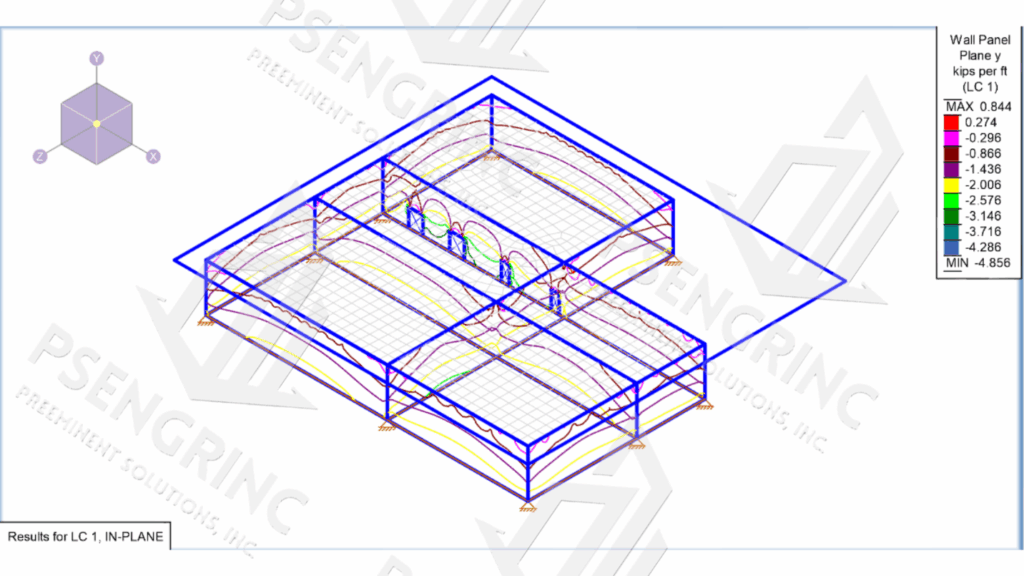
No material or destructive testing was performed for the purpose of this report.
During the site inspection at the Training Facility, the following observations and deficiencies were noted by the inspecting engineer:
- Existing Infilled Opening (North Wall)
- Proposed New Opening (South Wall)
- Surface Cracking and Patching
- Load Transfer Uncertainty
Recommendations
There are several unknowns associated with the existing structure at the Southwest Airlines Training Facility.
Further field verification, testing, and/or review of the original structural and as-built drawings is required to obtain the necessary data to finalize retrofit and modification details.
- Structural Wall Modifications and Openings
New openings are proposed through existing tilt-up concrete wall panels along the north–south dividing wall between suites.
Tilt-up panels at this facility are load-bearing and may contribute to gravity load transfer and lateral load resistance through diaphragm action.
Therefore, structural verification and controlled modification are required prior to any wall penetration.
- Roof and Truss Areas
Prior to modification, verify roof loading conditions and confirm that adjacent tilt-up walls are not supporting roof diaphragm anchorage.
Conduct GPR or infrared scans near the wall-to-roof interface to ensure that roof anchors or connections are not disturbed.
All work shall comply with the 2023 Florida Building Code (Building and Existing Building, 8th Edition) and applicable ACI and ASCE standards.
Conclusions
The subject structure, a tilt-up concrete facility, is generally in serviceable condition; however, proposed modifications involving new wall openings through existing tilt-up panels warrant careful structural evaluation.
Due to the degree of unknowns regarding panel reinforcement, load paths, and the building’s diaphragm interaction, further inspection, testing, and review of original structural and as-built drawings are required before proceeding with any cutting or retrofit work.
It is recommended that all findings outlined in this report—particularly those relating to GPR scanning, structural analysis, and potential lintel or edge reinforcement—be implemented prior to construction.
All work shall be performed in accordance with the 2023 Florida Building Code (Building and Existing Building, 8th Edition) and applicable industry standards.
Preeminent Solutions, Inc. reserves the right to supplement or amend the recommendations and associated drawings of this report should new information become available.